中国青少年音乐品味等级:
影响因素及相关心理
Musical Taste Hierarchy in Chinese Teenagers:
Influencing Factors and Associated Psychology
摘 要
随着数字音乐平台与社交媒体的高度普及,音乐逐渐成为中国青少年进行身份展示与社会互动的重要媒介,并形成了以“高雅”与“庸俗”为区分的音乐品味等级链。本文基于布尔迪厄的文化资本与区隔理论,探讨中国青少年音乐品味等级的具体结构、形成原因及其对心理状态的影响。研究采用混合研究方法,通过问卷调查与个体访谈,分析青少年对不同音乐类型的审美评价、社会经济背景和从众、同伴压力与自我呈现等心理机制,以及音乐品味等级导致的心理。研究发现,中国青少年普遍共享一套音乐品味等级认知:古典音乐虽非主流消费,却被高度评价为“高级”“有审美深度”,而流行音乐虽广泛聆听,却在象征层面被贬低。家庭收入与地区发展水平显著影响青少年对“高雅”音乐的接触与认同。同时,群体认同和归属感的需求与自我呈现、印象管理等心理机制促使青少年主动调整音乐表达,以适应群体规范。尽管显性排斥行为较少,但内化评价与心理疏离普遍存在,对青少年的社会交往与心理体验产生持续影响。
关键词:音乐品味、青少年心理、层级
Abstract
With the widespread adoption of digital music platforms and social media, music has gradually become an important medium for Chinese teenagers to showcase their identity and interact socially, forming a musical taste hierarchy determined by "refined" and "vulgar." This study, based on Bourdieu's theories of cultural capital and distinction, explores the specific structure, social and mental formation reasons, and psychological impact of this musical taste hierarchy on Chinese teenagers. The study employs a mixed-methods approach, using questionnaires and individual interviews to analyze teenagers' aesthetic evaluations of different music genres, socioeconomic backgrounds and psychological mechanisms such as conformity, peer pressure, and self-presentation that contribute to the formation of the hierarchy, and the psychological effects caused by the musical taste hierarchy.
The study finds that Chinese teenagers generally share a perception of the musical taste hierarchy. Classical music, though not mainstream consumption, is highly regarded as "refined" and "advanced", while popular music, though widely consumed, is devalued. Family income and regional development levels significantly influence teenagers' exposure to and identification with "refined" music. Simultaneously, the need for social conformity and belonging, along with psychological desires such as self-presentation and impression management, prompt teenagers to actively adjust their musical taste to conform to group norms. Although overt rejection is relatively rare, internalized evaluation and psychological distancing are prevalent, having a lasting impact on teenagers' social interactions and mental states.
Keywords: musical taste, teenager psychology, hierarchy
1. Introduction
The widespread adoption of social media in China over the past few decades has transformed artistic appreciation from a niche activity to a mainstream practice, with music standing out as a central topic of discussion across digital platforms. According to “Survey Data on Consumption Behaviors in China's Music Industry in 2025”, over 71% users of music platforms users participate in social interactions related to music, such as sharing playlists or discussing favorite artists, confirming that music has evolved beyond passive listening to a dynamic social medium. While this communal engagement with music brings emotional comfort and enjoyment, it has also given rise to a pervasive "musical taste hierarchy". Groups bound by shared musical preferences often adopt exclusionary attitudes, and individuals frequently display contempt for those with tastes perceived as "lower" in the hierarchical order. This hierarchy is not a natural or objective division, but a sociological construct that reinforces identity boundaries and social stratification, embodying Bourdieu’s (1979/1984) concept of "distinction," wherein taste functions as a tool for social differentiation. Existing studies on musical taste and hierarchy of art genres are common, but such studies with a focus on teenagers, who have unstable sense of identity and can be greatly influenced by peers, are rare. Thus, this study is both theoretically and practically meaningful, as it also aims to examine the influence of such hierarchy on the mental well-being of Chinese teenagers.
This study builds on Bourdieu’s theory and focuses on Chinese teenagers of age between 12 and 22. It aims to explore the influencing factors and associated psychology of musical taste hierarchy among Chinese teenagers through quantitative surveys and qualitative interviews. Based on the needs of theory and practice, this study attempts to propose and answer the following question: What is the hierarchy of musical taste among Chinese teenagers? What are the influencing factors of such a hierarchy? What is its impact on the mental conditions of Chinese teenagers? The obtained results can be used as a reference for diagnosing the mental states of Chinese teenagers.
2. Literature review
2.1 Classic Theories of Taste: From Aesthetic Universality to Empirical Norms
The discussion on taste and the sense of beauty can be traced back to the ancient Greek. Philosopher Aristotle stated that beauty is not woolly personal taste, but something measurable. In Critique of Judgement (Kant, 1790/1987), Kant brought out the idea of “Communis Sensus” (common sense), which he explained was an instinctive characteristic of tastes in beauty that ensures the universality and inevitability of aesthetic judgment. Kant’s idea was widely accepted, and the discussion moved onward to what taste is refined. From the perspective of classicism like Boileau-Despréaux, who mentioned in The Art of Poetry (Boileau-Despréaux, 1674/1970) that, classic taste, such preference for ancient works, sets the top standard for tastes. Meanwhile, empiricism held that taste norms should be empirical. In Of the Standard of Taste (Hume, 1757/1987), Hume argued that the standard of state should be built on the consensus of “perfect judges” developed through practice and comparison and free from bias. A refined taste should be collective and be accepted by the majority according to empiricists. Similarly, naturalists hold that taste is shaped by experience, but they emphasize it is essentially an emotional capacity to respond to sensory forms that align with human flourishing (e.g., colors, sounds, rhythms) and is functionally superior as it produces more enduring satisfaction. In Beauty (Santayana, 1896/1955), beauty is defined “pleasure objectified”, and that people experience pleasure and project it onto the object and thus calling it “beautiful”.
2.2 Sociological Perspectives: Taste as Social Distinction and Identity
2.2.1 Bourdieu’s Distinction Theory and Taste Classification
French sociologist Bourdieu set forth social factors determining the formation and formulation of taste. In Distinction: A Critical Judgement on Taste (Bourdieu, 1979/1984), he defined taste as a kind of cultural capital shaped by class, which is the means and outcome of establishing social positioning and class division. It is not an objectively existing entity. Refined tastes have always been the tastes of those in cultural dominance with the formulation of tastes serving social purposes like yielding power and elevating social status. Yet Bourdieu also divided taste into three types corresponding roughly to class structure, which are legitimate, middle-brow, and popular taste.
Legitimate taste, associated with the upper class and intellectuals, constitutes high cultural capital. It is typically abstract and formal, valued for its inherent form rather than immediate pleasure or practical utility, with examples including classical music, modernist literature, and fine arts. Middle-brow taste, a partial form of cultural capital shared by the petty bourgeoisie and upwardly mobile middle class, imitates legitimate taste to convey being cultivated but in more accessible forms (e.g., popular classical music, museum visits). Popular taste, linked to the working class, is marked by limited cultural capital and stronger economic constraints; representative examples, like pop music and genre films, reflect its focus on immediate pleasure, practicality, and rejection of the abstraction inherent to the other two taste types.
Through this classification, Bourdieu highlighted that legitimate taste tends to reject alternative tastes or display condescension. Its establishment by the upper class allows the transformation of differences in the way of acquiring culture into natural differences, and regards the cultural relationships with the slightest traces of cultural formation as the only ones with orthodoxy, thereby naturalizing the true differences. Hence, Bourdieu opposed the belief in the existence of “pure taste” and partially rebutted Kant’s theory, arguing that aesthetic common sense is a social and historical construct rather than an innate trait. The perceived "innateness" of taste, he contended, stems from inherited cultural capital that shapes individuals’ subsequent behavioral and aesthetic habits.
2.2.2 Modern Extensions: Minimal Group Paradigm
Moving to modern times, researches continue their studies on the construction of taste and its consequent forms of discrimination. This tendency to discriminate between groups with differing tastes can be explained by the minimal group paradigm (Tajfel, 1970): individuals inherently perceive their in-group (shared taste community) as superior to out-groups, fostering intergroup bias and discrimination, even when group divisions are based on trivial, practically meaningless differences.
2.3 Localized Studies on Taste in China
Parallel to Western scholarship, Chinese researchers have also delved into the notion of tastes. Fan (2007) introduced the concept of “fake”, or artificial taste, which arise not from instinctive impulse but from external pressures such as moral norms and social desires. According to Fan, artificial taste often misaligns with individuals’ actual educational levels and cultural traditions, coming at the cost of suppressing human nature. With the rapid rise of Internet, some studies also shift their focus to the practice of taste within online interactions. Chen’s (2014) study identified the hierarchical dissemination structure of social networks, which has led to the gradual solidification of online sub-culture groups around their own tastes and their commitment to self de-massifying or showing their interests are niche. On a micro level, this process has involved individuals in the self-driven process of social network cultural trends. In the process of cultural development, tastes have become the core of cultural construction and means of deviating from the dominance of mainstream tastes.
2.4 Reasons for the Formation of the Musical Taste Hierarchy
2.4.1 Explanation: Social Conformity and the Sense of Belonging
Built upon earlier studies on the essence and formation of taste, scholars have turned their attention to the reasons behind the hierarchization of tastes. A central explanation focuses on the human need for social conformity and a sense of belonging. Wu (2018) illustrates this idea through his analysis of major hierarchies and fan hierarchies in modern China. He argues that individuals’ continuous need for identity construction, together with sequences of recognition, forms the basis of hierarchical structures. These hierarchies are constantly produced under the guidance of modernity and exhibit characteristics such as rationality and science. Through the operation of social capital, individuals may actively or passively obtain specific identities within these recognition sequences. This process reflects the internalization of contemporary norms and values, through which taste hierarchies are reproduced and consolidated. Seen from this perspective, taste hierarchy is not solely an aesthetic judgment, but a social mechanism shaped by conformity and the pursuit of collective recognition.
Building on this line of inquiry, Li and Chen (2024) examined the traits of hierarchies of tastes in modern society. In the age of social media, the expanded right to express personal opinions allows extensive exchange of information, bringing the public into a more diverse world. People actively highlight their own advantages and showcase their niche personal interests to bond with others, thus building a strong sense of belonging among the members within a group. This sense of belonging is further strengthened by constructing a hierarchy with the lower levels as "others", thereby enhancing the identity of the group. As a result, the taste hierarchy that forms a sense of belonging within the interest group and a sense of superiority outside the group can be established in various aesthetic realms.
2.4.2 Explanation: Self-Presentation and Impression Management
Besides the need for a sense of belonging, self-presentation has also been identified as a contributing factor to musical taste hierarchies. The concept of self-presentation was first proposed by Goffman (1959), whom in his work mentioned how individuals frequently take certain action to control, shape, and modify the others’ impressions of them during social interactions. This concept was later applied to the study of musical tastes and class structure by Fang and Hua (2022). They observed that individuals will present themselves with careful management of the information displayed on online platforms to construct and shape an online identity that combines the "real self" and the "ideal self with the aim of influencing others' perception of themselves. Meanwhile, individuals also involve in taste displays, using cultural symbols, such as music preferences, to distinguish "our group" from "other group" in order to assert their uniqueness to others.
2.5 Omnivorous Taste
Finally, with the development of music consumption patterns and the alleviation of class divisions, the barriers between refined and popular culture have become less distinct. For instance, Peterson and Kern (1996) discovered that individuals from higher social classes or those who appreciate refined culture tend to have a more diverse taste than the general population, a phenomenon they termed “omnivorousness”. This musical taste pattern can also be seen in China. Zhu (2017) mentioned in his work that omnivorous (or compatible) music consumers are more prevalent among urban populations than single-type consumers. He further found that individuals with higher-income or higher educational background, and women are more likely to exhibit omnivorous musical tastes, while age is not related to this characteristic.
2.6 Research Gaps and the Position of This Study
Despite extensive literature on taste hierarchies and cultural distinction, three critical gaps persist, which this study seeks to address.
First, most studies focus on adults or general cultural consumers, overlooking teenagers who face unstable self-identity, heightened peer sensitivity, and ongoing socialization. Their unique psychological needs (e.g., belonging, self-presentation) and limited socioeconomic autonomy shape distinct engagement with musical taste hierarchies, yet this demographic remains under-explored.
Second, existing research often isolates structural factors (e.g., Bourdieu’s class and cultural capital) from psychological drivers (e.g., identity construction, conformity). Few systematically link socioeconomic background (regional development, family income) with psychological mechanisms (peer pressure, impression management) to explain how youth musical taste hierarchies form and persist.
Third, western theories lack sufficient validation in Chinese youth contexts, where traditions, norms, and socioeconomic stratification differ significantly. Meanwhile, only a few Chinese scholars target musical taste. Moreover, they often emphasize the reasons for formation of hierarchies but underemphasize their mental impacts on teenagers.
This study positions itself as a targeted response to these gaps: It extends Bourdieu’s theory to Chinese youth, tests Western frameworks’ cross-cultural applicability, and integrates investigations of psychological effects. A mixed-methods design (quantitative surveys and qualitative interviews) captures both general patterns and contextualized experiences, filling the gap in youth-focused and music-specific research. It prioritizes the hierarchy’s mental impacts on teenagers, providing empirical support for targeted interventions to foster psychological well-being.
By addressing these gaps, the study enriches cultural hierarchy and youth culture literature while offering actionable insights for educators, parents, and mental health practitioners.
3. Research Methods
This research consists of quantitative questionnaire and qualitative interviews to analyze and examine 2 individual cases. The research acknowledges musical taste hierarchy as a phenomenon that shares collective perception and involves evaluative judgements and internal mental states which can be indirect and implicit.
3.1 Questionnaire
The questionnaire is based on the aim of this study to identify the existence of musical taste hierarchy among Chinese teenagers, the mental and social factors that contribute to its formation, and its mental impact on teenagers. This questionnaire fundamentally builds on the existing hierarchy of music genres mentioned in existing works of Ren (2020), Fan (2007), and Wu (2018), where classical music is located at the top of the hierarchy and popular music is at a lower level. Therefore, classical music is assumed in this research as being a representation of refined taste, and popular music is assumed as a representation of popular taste.
The target population of this research is Chinese teenagers and young adults, primarily aged between 12 and 22. Respondents are from different regions of China (urban and non-urban areas) and with different family income level, parent educational level and respondents’ own educational level. The variety of respondents ensures external validity and allows for comparative analysis across socioeconomic backgrounds.
The questionnaire consists of 6 sections, each serving for the following information: demographic information, music listening habits, aesthetic evaluative of music genres, mental motivations for constructing the musical taste hierarchy, psychological impact, and general advice and questions for this research. Most questions are multiple-choice questions or scale-response questions.
The questionnaire was designed and sent via the Chinese online questionnaire platform, Wenjuanxing. Respondents were reached via public social media platforms commonly used by targeted population, like Wechat, Weibo, Xiaohongshu, and Baidu Tieba. An introduction that describes the topic and purpose of the questionnaire is stated at the beginning of the questionnaire, encouraging respondents to complete the questionnaire with honesty and promising the results will be anonymous, confidential, and only for academic research use. Collected data was analyzed using descriptive statistics and cross-analysis methods. The analysis focuses on systematic construction of musical taste hierarchy and collective mental patterns of Chinese teenagers.
3.2 Interview
The qualitative interviews aim to go beyond quantitative data collected by the questionnaire and integrate contextual understanding into the study by examining lived experiences and emotional effects that cannot be fully revealed through questionnaires. Its purposes are to identify the practical significance of musical taste hierarchy among Chinese teenagers, including its concrete manifestations, forms of exclusion, and detailed mental impact (changes in feelings and emotional state).
The two participants were selected after they stated their willingness to undergo a follow-up interview and voluntarily provided their contact information in the last question of the questionnaire, and based on their experience and music preferences shown in their questionnaire results. Interviews were conducted separately and online via Tencent Meeting, and last 15-20 minutes. A semi-structured interview guide was used while allowing participants to elaborate on their personal experiences and mention things relevant to the research but had not been initially considered.
3.3 Research Hypotheses
Based on existing literature on cultural capital, psychological needs of men, and hierarchy on art and culture, the research tests the following hypotheses:
H1: Chinese teenagers share a musical taste hierarchy that is based on evaluation, not listening frequency
H2: Socioeconomic background contributes to the formation of musical taste hierarchy among Chinese teenagers
H3: Musical taste hierarchy is sustained through mental factors, such as the need for the sense of belonging and social conformity, peer pressure, and impression management or self-presentation.
H4: Musical taste hierarchy has explicit mental impact on Chinese teenagers, including positive and negative changes.
4. Research Analysis
4.1 Questionnaire Data Analysis
4.1.1 Sample Overview
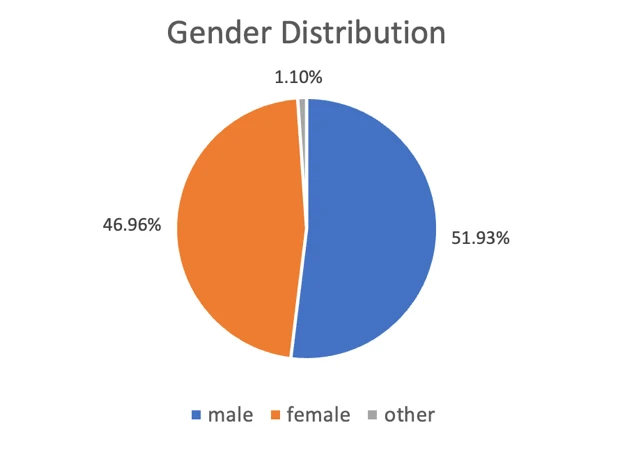
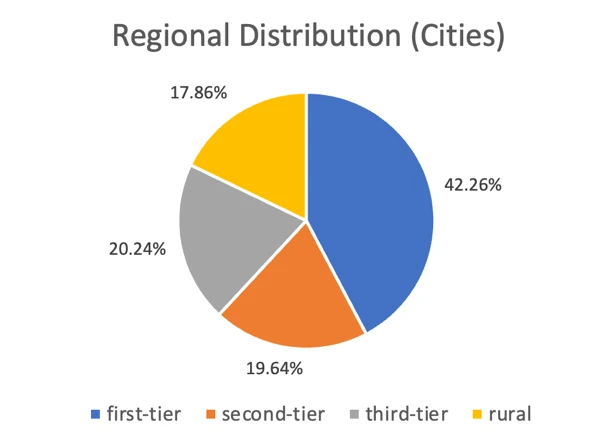
Data were collected from a total retained sample of 166 respondents (Chinese teenagers aged 12–22 who listen to music), after excluding incomplete and irrelevant sample. The sample was relatively balanced in terms of gender (52% male, 47% female). In terms of social background, respondents came from regions across China, including first and new first-tier (42%), second-tier (20%), third-tier cities (20%), and rural areas (18%).
Music listening is a frequent daily activity for the respondents: over 83% listen to music at least several times a week, 51% listen daily, and 71% spend more than 30 minutes per day listening. Listening contexts were diverse, including commuting, relaxing, and social settings, indicating that music consumption among Chinese teenagers is highly functional rather than limited to pure aesthetic appreciation. These listening patterns lay the foundation for analyzing how musical taste hierarchies interact with teenagers’ daily music engagement.
4.1.2 Structure
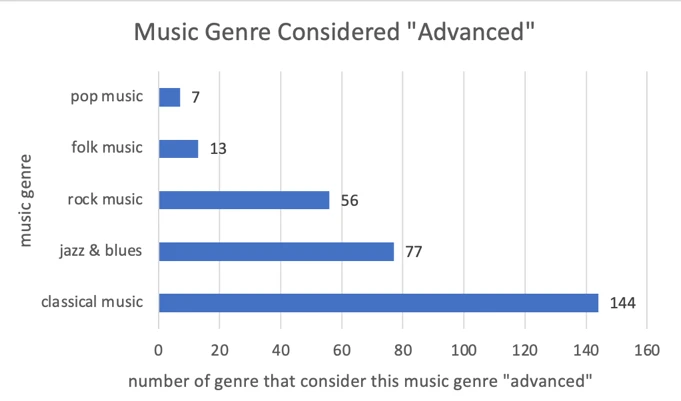
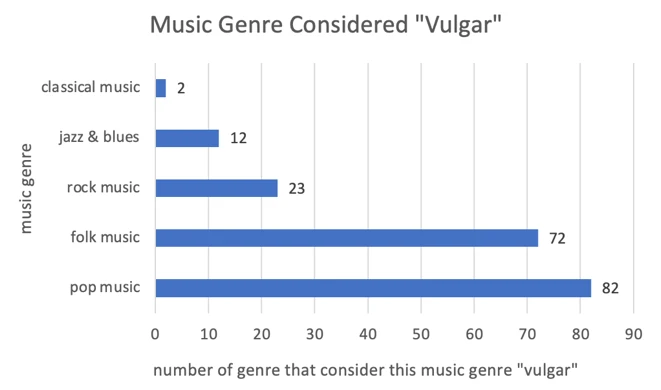
The musical taste hierarchy is commonly perceived and shared. Over 60% of respondents agree on a ranking of superiority and inferiority between music tastes. When asked to associate music genres (classical music, rock music, jazz and blues, country music/folk songs, Chinese traditional music, pop music) with specific evaluative descriptions, 86.75% respondents associate classical music with being “advanced”. In contrast, pop music is frequently seen as “vulgar” (49.4%) and rarely as “advanced” (4.22%). 62.65% respondents also believe classical music listeners “have better musical taste, aesthetic sense and appreciation ability”, while believing those who actively enjoy or are fond of the highly popular songs “have poorer musical taste, aesthetic sense, and appreciation ability” (51.2%). The majority’s clear distinction between positive impression on classical music as “advanced” and negative impression on pop music as “unadvanced” demonstrates musical taste hierarchy as a collective perception, shaping how general teenagers cognitively categorize and evaluate music.
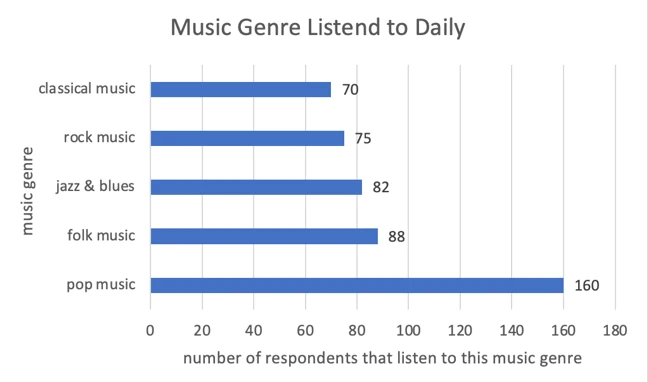
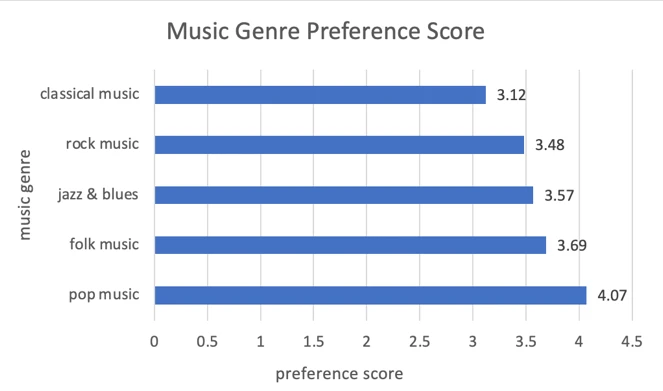
However, the frequencies of music listened to daily and ranking results of respondents’ musical preference (how they like the music genres) reveal a clear pattern almost opposite to the musical taste hierarchy. Classical music is listened by only 42.17% of respondents daily and received one of the lowest preference scores (3.12), yet it is overwhelmingly associated with “advanced,” “classic,” “deep,” and “expensive” in the evaluation questions. Pop music is listened by 96.39% of respondents daily and received the highest preference score (4.07), but was often recognized as “vulgar” (49.4%) and “unadvanced” (only 4.22% agree on “advanced”). This divergence between symbolic status (characteristics and impression) and actual listening patterns suggests that respondents differentiate between their behavior and their recognition of superiority. These findings support H1, indicating that Chinese teenagers widely perceive an implicit musical taste, with classical music occupying the top and pop music occupying lower positions.
4.1.3 Causes
4.1.3.1 Socioeconomic Background Determines “Refined”
The cross-analysis shows the correlation between geographical region of respondents and respondents’ music consumption patterns. In first-tier cities, the consumption classical music is more likely due to life requirements, like socializing (32%), while this is less likely in second-tier cities (16.67%) or below. Respondents in developed areas like first- and second-tier cities are also less likely to perceive classical music “costly”, (67.61% and 51.52%), compared to the percentage of respondents in less developed regions like third-tier cities and rural area who perceive the same way (82.35% and 80%). These results show that the consumption of classical music is more common in developed urban cities as it fits with the consumption idea of urban citizens and exist more often in urban social life. Socioeconomic context shapes not only access to classical music but also its perceived refinement and practicality in everyday life. In more developed urban regions, greater economic and cultural capital normalizes classical music as a functional and socially embedded form of “refined” culture, reinforcing its higher position within the musical taste hierarchy.
Family income level functions similarly as regional background. Cross analysis has also shown that as family annual income rises (from 150K or below to 1M or above), respondents’ preference for pop music generally falls (from a score of 4.13 to 3.95), but their preference for classical music generally rises (from 2.74 to 3.18), both with a significant difference between income above or below 150K). The percentage of respondents who listen to pop music remains generally constant across all income groups (over 95% for all), but only 4.35% of respondents with family annual income below 150K listen to classical music.
Respondents from higher income family listen to classical music mainly due to personal preference and life requirements, indicating that they mostly actively choose classical music, instead of encountering classical music passively or accidentally, such as being randomly recommended classical music by the platform, a common case for respondents from lower income family (54.55% for 150K-300K). Respondents from higher-income family also show greater tendencies to associate classical music, jazz, and blues with being aesthetically “beautiful”, indicating that respondents with higher economic capital are more likely to have the ability to appreciate symbolically “refined” music, suggesting that economic capital empowers internalized refined taste for appreciating legitimized art forms.
Together, regional and family-level socioeconomic advantages allow for internalized appreciation for symbolically refined music and contempt of other music genres, and thus structurally produce and sustain a hierarchy of musical taste.
4.1.3.2 Mental Causes: Conformity and Peer Pressure
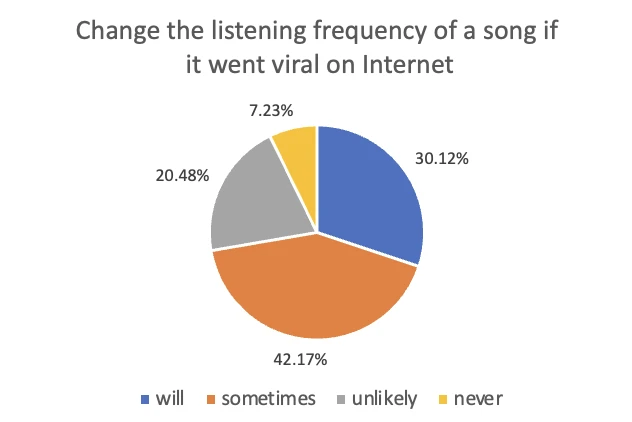
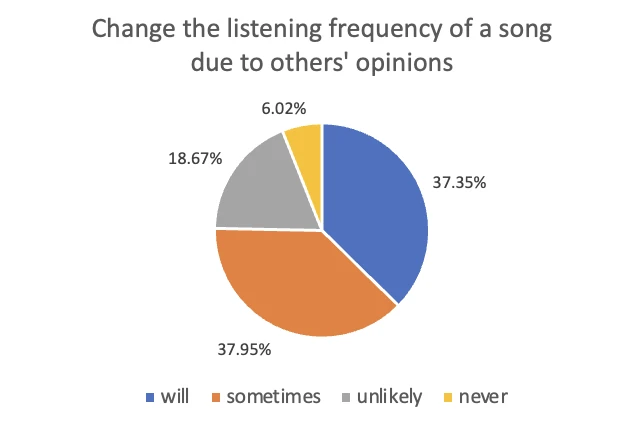
When asked whether they will change listening frequency of the song that went viral on Internet, over 70% of respondents admit that they also generally will, suggesting that mass popularity itself devalues aesthetic and lowers its status in the musical taste hierarchy. Over 75% of respondents admit that they generally will change their frequency of listening to a particular song due to the opinions of people around them regarding this song, with 37.35% choosing “will” and 37.95% choosing “sometimes will”. This shows that music preference is highly sensitive to peer evaluation. Teenagers will actively adjust their listening behavior to align with collectively accepted standards within their social group. The results together reveal that musical taste hierarchy among teenagers is sustained through collective conformity instead of individual judgement. As avoidance of extremely popular music becomes a widely shared idea, peer pressure is generated, as continuing listening to viral songs risks misaligning with the majority of peers. In this way, shared rejection towards mass popularity leads to conformity that reinforces hierarchical difference between pop music, which usually is widely popular and considered “vulgar”, and more “refined” music like classical music, and shape teenagers’ musical taste through collective social evaluation.
4.1.3.3 Mental Causes: Impression Management and Self-presentation
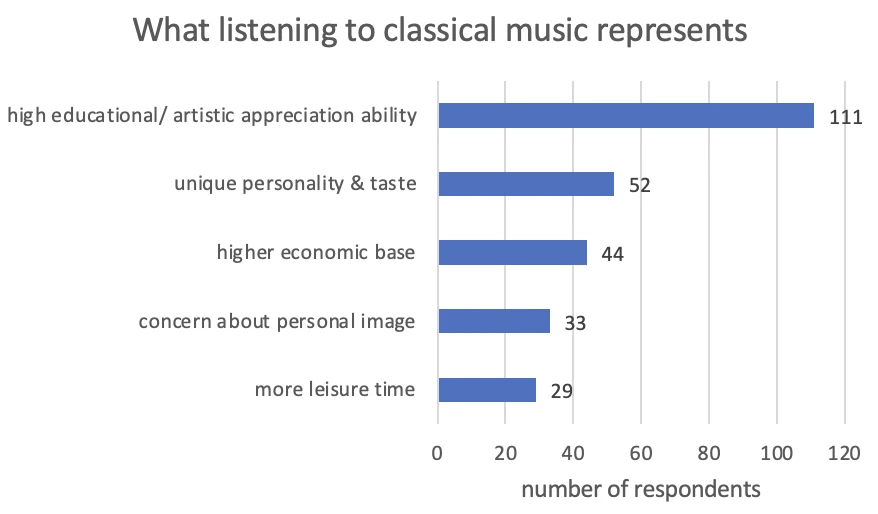
The results also reveal that teenagers consciously use musical taste to signal their identities and manage others’ impression on them, while this process of impression management in return consolidates the musical taste hierarchy. Respondents generally associate classical music with being “advanced” (86.75%), “deep” (69.28%), “beautiful” (56.02%), “costly” (70.48%), and “classical” (71.69%), and believe listening to classical music represents “having relatively high educational level or high artistic appreciation ability” (66.87%) and “having a unique personality and taste” (31.33%). This consensus indicates that musical genres are embedded with strong social meanings related to intelligence and aesthetic refinement. The average score of the extent to which respondents care about the image conveyed or others’ opinion on him/herself when sharing music online is relatively high (6.71), indicating that Chinese teenagers are aware that their musical tastes may lead to themselves being interpreted and evaluated. Hence, they may strategically adjust their displayed musical taste make their self-image more favorable as a form of self-presentation. This concern for impression management reinforces musical taste hierarchy, as when teenagers displayed their preference for “high-status” genres like classical music to enhance their self-image, they actually reaffirm the superiority of these genres. Over time, repeated acts of individual self-presentation accumulate into a stable and common social structure, where certain musical tastes are consistently elevated and others devalued.
4.1.4 Omnivorous Taste
Data have shown that each respondent listen to various music genres daily, with an average number of 3.34 types. The number of music genre listened by respondents has not shown a clear relationship with respondents’ ages, education level, family income level, parents’ education level, regions or any other demographic background. Hence, it can be concluded that individual possessing multiple musical taste is a common phenomenon and is widely applicable and indetermined by demographic factors.
4.1.5 Dynamic Existence of the Hierarchy
The musical taste hierarchy appears to be dynamic. Though classical music is widely recognized as “advanced”, its highest position itself becomes a target of disdain, resulting in a symbolic resistance or counter-hierarchical behavior. Shown by data, 10.24% of respondents associate classical music with being “pretentious”, a kind of downward moral devaluation and attack of the legitimacy of a “refined” taste widely acknowledged by the majority. 12.05% of respondents also believe people actively listen to or appreciate classical music “for show”, indicating their suspicion to the motivation behind listening to classical music and take it as evidence of performativity. These results point toward some teenagers questioning the motives and authenticity behind refined taste, making the once collectively-reckoned and stable musical taste hierarchy dynamic and continuously negotiated.
4.1.6 Psychological Impact
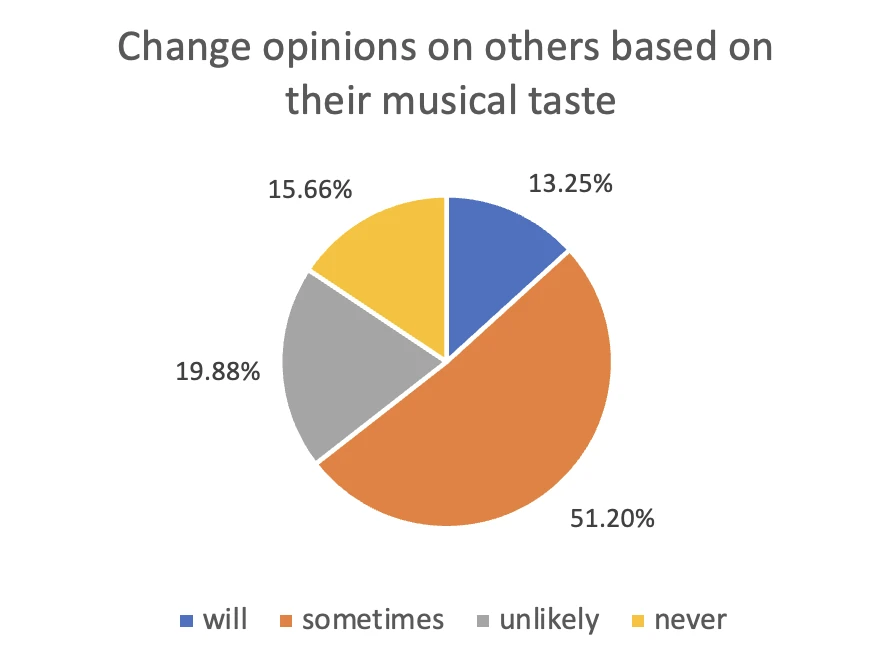
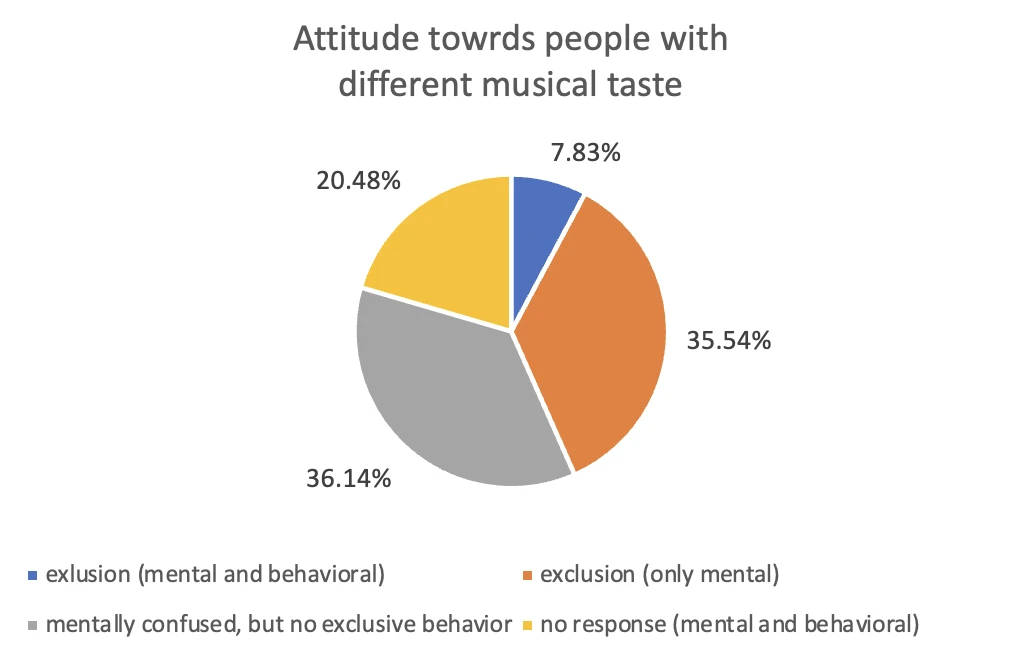
The data indicates that musical taste hierarchy has a substantial psychological impact on Chinese teenagers, primarily by shaping how they perceive others and regulate their own social behavior. Over half of the respondents report that they will change opinions on others based on their musical tastes, with 51.2% admitting “will” and 13.25% admitting “sometimes will”. Most respondents also believe classical music listeners, people with “refined” taste according to the musical taste hierarchy, “have better musical taste, aesthetic sense and appreciation ability” (62.65%), while those who actively enjoy or are fond of the highly popular songs and having “vulgar” or popular taste, “have poorer musical taste, aesthetic sense, and appreciation ability” (51.2%). These results suggest that the perceived hierarchal order of music genres signals teenagers to evaluate others in certain ways according to the status of their musical taste in the hierarchy. Over 40% of respondents admit they will have inner aversion towards people with different musical tastes, and 36.14% report being confused by people with different musical tastes. However, only 7.83% of respondents, though have inner aversion, display concrete exclusive behavior, while others don’t act explicitly exclusive. 46.99% of respondents report being welcomed by individuals or groups based on their musical taste, whether it is appreciating or disliking certain music genres. Meanwhile, only 24.7% of respondents report being excluded by individuals or groups based on their musical tastes. These responses indicate that musical taste hierarchy is effective as it leads to Chinese teenagers’ evaluation of peers based on musical taste, discomfort emotions, and autonomous distancing behavior during interaction and social activity. In particular, effects on inclusion and acceptance are significant while overt or perceived exclusionary behavior is less common but still exist. Internalized hierarchy and silent judgement, such as altered opinions on others, are widespread among teenagers.
4.2 Interview: Elaboration on Psychological Impact
Two interviewees are Chloe (Pseudonym) and Joseph (Pseudonym). Both are high school students in Shanghai, listen to a variety of music, and have great interest in music. The interview results provide a concrete illustration of how musical taste hierarchy psychologically influence Chinese teenagers.
Both interviewees clearly exhibit evaluative judgement toward others based on hierarchical musical taste and take action in response to the evaluation, suggesting that musical taste hierarchy influence in terms of their mentality and behaviors. Joseph associate people who “merely pursue mainstream pop music and blindly listen to those meaningless pop songs” with “lack of taste” and “low aesthetic level,” and admits that such judgement affects his inner attitude towards others, even when it does not necessarily result in overt exclusionary behavior. Though he describes this impact as primarily psychological, he also adds that he will be more cautious in actual social interactions and less willing to assign creative or aesthetic-related tasks to such individuals whose tastes he deems inferior. This illustrates how musical taste hierarchy shapes trust and perceived competence of others, rather than purely likes or dislikes.
Similarly, Chloe demonstrates a stronger and more explicit form of hierarchical judgement and behavioral response. She openly expresses contempt toward listeners of Chinese “formulaic pop songs” and viral TikTok songs, describing feelings of “disdain and reject” when encountering people with such musical taste. Although she distinguishes between friends and unfamiliar individuals, her thoughts reveal that musical taste functions as an efficient screening mechanism that determines whether someone is “worth connecting”. Musical taste hierarchy allows teenagers to form quick impressions of others in social environments, even at the cost of reinforcing stereotypes and prejudice.
Beyond judging others, the interviews also reveal how musical taste hierarchy influences self-perception and emotional experience. Joseph says his preference for classical and jazz music made him “feel proud and superior when he was younger”, accompanied by a sense of emotional distance from peers who favored pop music. Although he later reflects more critically on this mindset, this experience still demonstrates that refined musical taste leads to positive self-evaluation such as confidence, while simultaneously fostering isolation and implicit arrogance. This dual effect aligns with the questionnaire findings that musical taste hierarchy have both positive and negative psychological consequences.
Chloe’s experience highlights another dimension of mental impact: anxiety and self-regulation under social pressure. While she insists that others’ opinions cannot fully determine her musical preferences, she admits that widespread criticism of a music genre she listens to, such as “criticism of Western pop being too explicit, leads her to reduce listening frequency and avoid displaying preference for Western pop music on social media. Her response demonstrates how teenagers actively adjust behavior related to musical taste to prevent negative judgement. This confirms that musical taste hierarchy exerts mental pressure like causing insecurity and caution on teenagers.
Finally, both interviews show that musical taste hierarchy subtly structures social interaction between teenagers, especially when it comes to cooperation and making friends. Shared musical preferences are described as having common interests, facilitating emotional closeness and communication, and a sense of mutual understanding, while different tastes, especially hierarchical inferior ones like mainstream pop music, cause discomfort, awkwardness, or hesitation. In both interviewees’ cases, the hierarchy manifests mostly as silent mental distancing, selective interaction, and emotional filtering.
Overall, the interviews confirm that musical taste hierarchy among Chinese teenagers has a significant psychological impact by shaping how individuals evaluate others, regulate their self-image, experience emotions such as pride, aversion, and anxiety, and manage social relationships. These qualitative insights enrich and deepened the questionnaire data by revealing the lived and concrete psychological mechanisms through which hierarchical values of musical tastes are exhibited and reproduced in everyday life.
5. Discussion and Conclusion
5.1 Result and Readdressing the Research Questions
Results from both the questionnaire and interview have answered the three core questions of the research. They demonstrate that a hierarchical structure of musical taste based on evaluation and recognition of refinement and superiority exists among Chinese teenagers that supports H1. They also support H2 and H3 by pointing out several mental and social factors that contribute to its formations and sustain its existence, such as family income level and regions, the desire for social conformity, peer pressure and the need for impression management. Finally, the data supports H4 and reveals that musical taste hierarchy has clear psychological impact on teenagers. Internalized evaluation and judgement, active distancing and emotional discomfort can be caused by the hierarchy.
5.2 Significance in Academic Context: Support, Challenge, and Innovate
This research contributes and extends existing studies on musical taste or cultural hierarchy by shifting focus from its structural formation to mental states, and from general population to focus on teenager population.
This research strongly supports Bourdieu’s (1979/1984) idea of tastes as cultural capital that reflect and reproduce class structures and contributes to distinction. Music genres associated with refinement are generally seen as aesthetically superior and enjoyed more often by teenagers from higher socioeconomic backgrounds. However, this research also diverges from Bourdieu’s theory by showing that access to cultural products is not the primary mechanism of distinction in modern Chinese society. The symbolic hierarchy still exists even with the rise of digital music platforms because of difference in individuals’ ability to interpret “refined” culture and actually acquire “refined” taste.
The study challenges Kant’s (1790/1987) notion of universality of aesthetics grounded in the artistry. The findings indicate that perceptions of music genres are socially constructed and agreed upon due to social and mental factors. The hierarchy of musical tastes does not reflect the collective actual preference for music or the different levels of artistry of various music genres.
The findings also support Peterson and Kern’s (1996) theory of cultural “omnivorousness”. While respondents display broad listening habits across multiple genres, this inclusivity does not dismantle hierarchy, suggesting instead that hierarchy has shifted from behavioral exclusion to symbolic differentiation. Moreover, the findings challenge Chinese scholar Zhu’s (2017) work, demonstrating that the omnivorous pattern of musical taste has no clear relationship with teenagers’ socioeconomic background, whether it is the regions they live in, their family income, or their genders. The omnivorous taste is widely displayed by Chinese teenagers.
Finally, this study primarily focuses on Chinese teenagers, a group of individuals who is highly responsive to peer pressure and social evaluation and whose personal identities may not yet be formed and is continuously evolving. The findings contribute to the literature on youth culture by demonstrating that musical taste hierarchy emerges before adulthood and indicating that taste-based distinction and hierarchical order of taste are not merely consequences of class or economic status, but an early socialization process through which teenagers learn to navigate status, belonging, and identity.
5.3 Significance in Social Context: Discern, Understand, and Prevent
Beyond theoretical contributions, this study has practical values. The findings help discern the subtle psychological effects on Chinese teenagers due to the musical taste hierarchy, including constant mental signals and pressure that influence or alter their self-image, emotional responses, and social behaviors towards others. Recognizing the patterns and understanding the psychological mechanisms allow hidden judgment be identified and explained. This awareness is crucial for teenagers to address their own subtle emotions, including anxiety and confusion during identity formation. Finally, the findings also provide reference for possible remedies to prevent or mitigate mental pressure or harmful social behaviors caused by musical taste hierarchy. By separating aesthetic appreciation from moral judgment, schools and families can reduce the tendency of teenagers to equate musical taste with personal competence or value. Encouraging diversified aesthetic values and open discussion of taste hierarchy may help teenagers cope with internalized pressure and promote an inclusive and healthy social environment.
5.4 Limitation and Improvement
First, the research relies on self-reported data. Respondents may not report their biases or implicit behaviors and thoughts due to unconsciousness and social desirability. Future scholars can employ experimental designs, such as controlled listening experiments to distinguish between emotional enjoyment and social recognition.
Secondly, the sample skews towards urban and relatively higher-income population, which limits the generalizability of the findings to all teenagers across China, reducing its external validity. In the future, stratified sampling across city tiers or quota sampling based on family income can be adopted to improve generalizability.
Finally, this study focuses purely on musical taste hierarchy, but the hierarchy may exist in other realms as well. Future scholars may conduct research on film or literature to reveal broader patterns of cultural hierarchy. Comparative studies across cultural contexts may also be designed to explore whether the influencing factors and effects of hierarchies are various or universal. Scholars may also examine through longitudinal studies on how aesthetic hierarchies evolve as individuals age and accumulate social experience and capital.
5.5 Conclusion
This study shows that a musical taste hierarchy is widely perceived and collectively shared among Chinese teenagers, with classical (and related) genres occupying a superior status despite lower actual listening frequency. The hierarchy is constructed and sustained by socioeconomic factors, like family income and regional development levels, and mental factors, like conformity, peer pressure, and impression management.
Importantly, the hierarchy has clear mental consequences. While explicit exclusion is relatively uncommon, inner judgment, emotional distancing, and self-regulation are widespread, shaping how teenagers perceive others and manage themselves. Musical taste thus becomes a social signal that influences belonging, self-value, and interaction.
By focusing on teenagers, this study highlights how cultural hierarchies are learned and internalized at early stages. It reveals that even with general access and diverse consumption, symbolic hierarchies of taste remain. This study is essential not only for understanding these mechanisms as a sociological study, but also for providing reference for addressing the subtle mental issues embedded in everyday life.
References
Boileau-Despréaux, N. (1970). The art of poetry (J. Dryden, Trans.). E. J. Brill. (Original work published 1674)
Bourdieu, P. (1984). Distinction: A social critique of the judgement of taste (R. Nice, Trans.). Harvard University Press. (Original work published 1979)
Goffman, E. (1959). The presentation of self in everyday life. Anchor Books.
Hume, D. (1987). Of the standard of taste. In E. F. Miller (Ed.), Essays: Moral, political, and literary (pp. 226–249). Liberty Fund. (Original work published 1757)
iiMedia Research. (2025, April 15). Survey Data on Consumption Behaviors in China's Music Industry in 2025.
https://www.iimedia.cn/c400/105706.html
Kant, I. (1987). Critique of judgment (W. S. Pluhar, Trans.). Hackett Publishing Company. (Original work published 1790)
Peterson, R. A., & Kern, R. M. (1996). Changing highbrow taste: From snob to omnivore. American Sociological Review, *61*(5), 900–907.
Santayana, G. (1955). Beauty. In The sense of beauty (pp. 13–25). Dover Publications. (Original work published 1896)
Tajfel, H. (1970). Experiments in intergroup discrimination. Scientific American, 223(5), 96–102.
陈龙. (2014). 网络亚文化的“趣味”及其价值意义分析. 青年研究, (5), 72–79.
范玉吉. (2007). 何为高雅趣味——谁的高雅趣味?——对文艺鉴赏标准的质疑. 学术界, (1), 103–106.
方格格., & 华伊然. (2022). 谁在决定品味?音乐流媒体平台的品味再造和阶层想象. 中国青年研究, (8), 101–108.
李丽珊, & 陈新儒. (2024). “鄙视链”与社交媒体时代的审美趣味圈层化之思. 内江师范学院学报, *39*(7), 122–128.
任浩砝. (2020). 音乐存在等级高低吗?——从鄙视链出发分析音乐认同的心理因素. 北方音乐, *12*(24), 221–223.
吴斯. (2018). 身份建构需求、认同序列与信息鄙视链的生产. 新闻与传播研究, 25(2), 5–20.
朱迪. (2017). 高雅品味还是杂食?——特大城市居民文化区分实证研究. 山东社会科学, (10), 35–43.
Appendix
青少年音乐品味调查问卷原始数据
青少年音乐品味调查问卷
图表数据分析
interview1-transcript_Shen Yutong
interview2-transcript_Wang Chaoyi